
For businesses in Dubai, having a strong social media presence is a big part of how they make sales and get customers. Since most of the population uses social media, businesses will most likely be shopped by people looking to validate and/or research their credibility.
Social media was made for content sharing but has evolved to be a more interactive part of the customer purchasing journey. Businesses can establish an active presence online that encourages customers to select them by improving fulfillment and recognition for their services.
The staff at Vertexs Digital has extensive knowledge and qualifications in building strong social media frameworks for different businesses in diverse sectors. It is evident from the demand for a more strategic approach to social media marketing that it far surpasses nonsensical posts, given the sustained and focused outcome that is evident.
Understanding Social Media Marketing in Dubai
Social media marketing is the process of using platforms like Instagram, Facebook, LinkedIn, and TikTok to connect with your audience, share content, and guide people toward your business. For businesses looking for a more structured approach, exploring professional social media marketing services in Dubai can help turn that visibility into consistent growth.
But in reality, it’s much more than just posting photos or videos.
It’s about:
- Staying visible even when users are not actively searching
- Reinforcing your brand after someone finds you on Google
- Creating repeated touchpoints that build trust over time
Many businesses misunderstand this. They expect instant leads, but social media works differently. It influences decisions gradually, often playing a key role before someone chooses to contact you.
If you want to understand how it fits into the bigger picture, you can explore our complete guide to digital marketing in Dubai, which explains how all channels work together.
How Social Media Marketing Builds Brand Authority
The influence of social media on public perception of your business is increasingly dominant. Due to social media’s prevalence, customers can easily research a business’s professionalism and reputation through their profiles before making inquiries and purchases.
Exhibiting activity and posting updates on your social media accounts allows you to reinforce your brand and show your expertise, your customers’ successes, and updates to your company. Incremental increases in customer engagement are an expression of trust, making them more likely to purchase from you.
Why social media matters so much in a competitive market
Dubai is fast-paced. People make decisions quickly, but they don’t make them blindly.
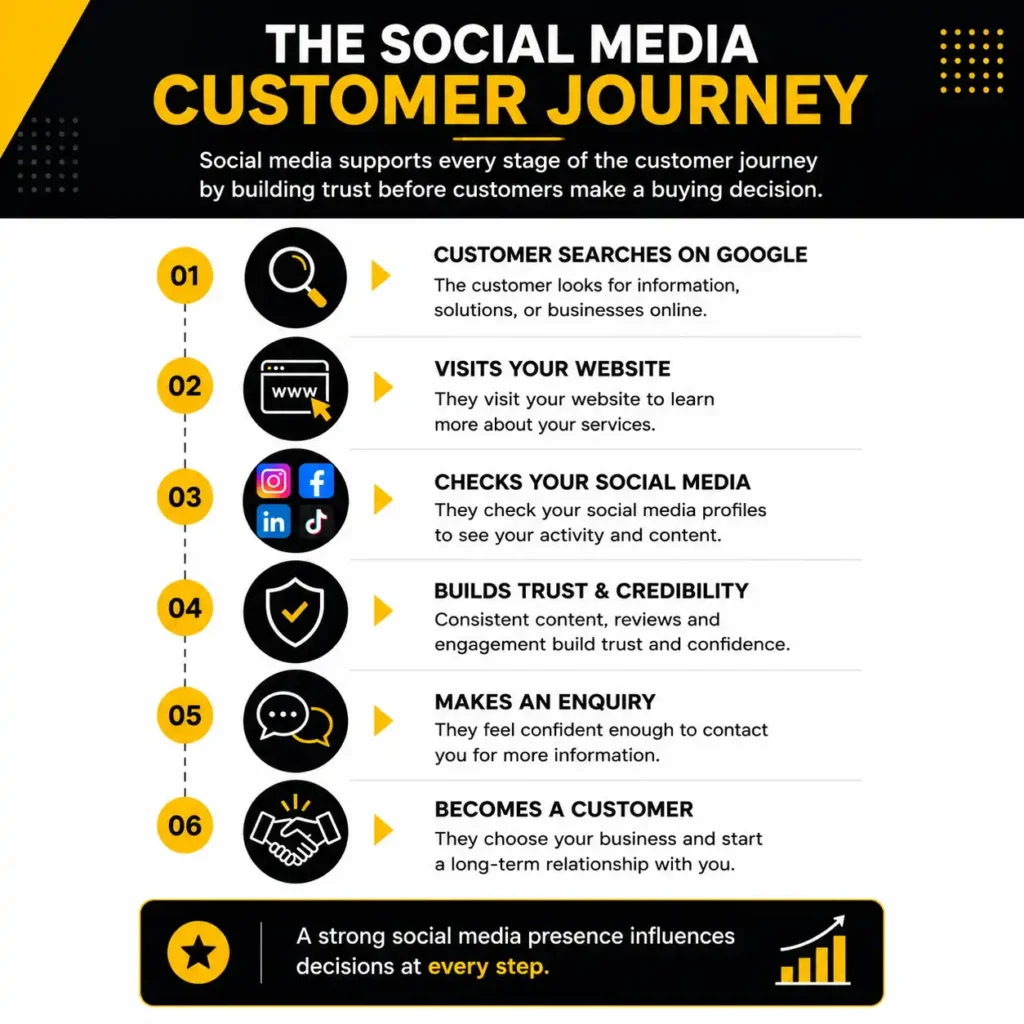
Before choosing a business, users typically:
- Search on Google
- Visit a website
- Check social media profiles
This means your social media is often part of your first impression.
If your profile is:
- Inactive
- Inconsistent
- Outdated
It can instantly reduce trust, even if your service is good.
On the other hand, a well-maintained profile signals:
- Professionalism
- Reliability
- Credibility
That’s why social media is not optional anymore — it’s expected.
The real role of social media in the customer journey
Social media rarely acts as the first or last step. Instead, it supports the journey in between.
Here’s what a typical path looks like:
- A user discovers your business (Google, ads, referral)
- They check your social media
- They form an impression
- They decide whether to trust you
This means your content is not just for engagement — it’s part of your decision-making process.
Even if someone doesn’t contact you immediately, your presence stays in their mind.
Choosing the right platforms for your business
Not every platform is equally important. The right choice depends on your audience and business type.
Best for:
- Service-based businesses
- Local brands
- Visual industries
It’s where people explore, scroll, and judge quickly.
Best for:
- B2B companies
- Professional services
- Corporate audiences
Here, credibility and expertise matter more than visuals.
Still useful for:
- Local targeting
- Ads
- Community engagement
TikTok
Best for:
- Fast exposure
- Creative content
- Younger audiences
The goal is not to be everywhere. It’s to be consistent where your audience actually spends time.
How to Choose the Right Social Media Platform
Instead of establishing a presence across all platforms, limit your focus to the platforms that meet your business goals as well as your customers’ needs. Before making a marketing investment, analyze your potential customers to see how they interact with platforms and content, as well as where they spend their time.
Visual content drives engagement, so Instagram and TikTok are great platforms for restaurants and brands in the fashion and beauty industries. Alternatively, B2B services and consulting firms are better off engaging with a LinkedIn audience and posting content that helps them establish their credibility and share their knowledge.
Quality content produced consistently on the best selected platforms results in marketing the goals of your business more easily and more effectively.
What kind of content actually works
Posting randomly does not work anymore. Your content needs structure.
A strong strategy usually includes:
1. Awareness content
This helps people discover you:
- Tips
- Educational posts
- Industry insights
2. Trust-building content
This helps people believe in you:
- Case studies
- Before-and-after examples
- Real results
3. Engagement content
This keeps your audience involved:
- Questions
- Opinions
- Interactive posts
4. Conversion content
This encourages action:
- Service explanations
- Offers
- Call-to-action posts
The key is balance. Too much selling pushes people away. Too much education without direction leads nowhere.
Consistency vs quality: what matters more?
This is a common question.
The truth is — both matter, but consistency often comes first.
If you post once a month, even great content gets forgotten.
If you post daily but with low quality, your brand perception suffers.
The ideal approach:
- Post 3–4 times per week
- Maintain consistent messaging
- Keep a recognizable visual style
Consistency builds familiarity. Familiarity builds trust.
How social media supports long-term growth
Social media is not just about short-term results.
It helps:
- Keep your brand visible
- Build recognition
- Strengthen credibility
Over time, this leads to:
- Better conversion rates
- Higher trust
- Stronger brand recall
People may not contact you today, but when they need your service later, they remember you.
Organic vs paid social media
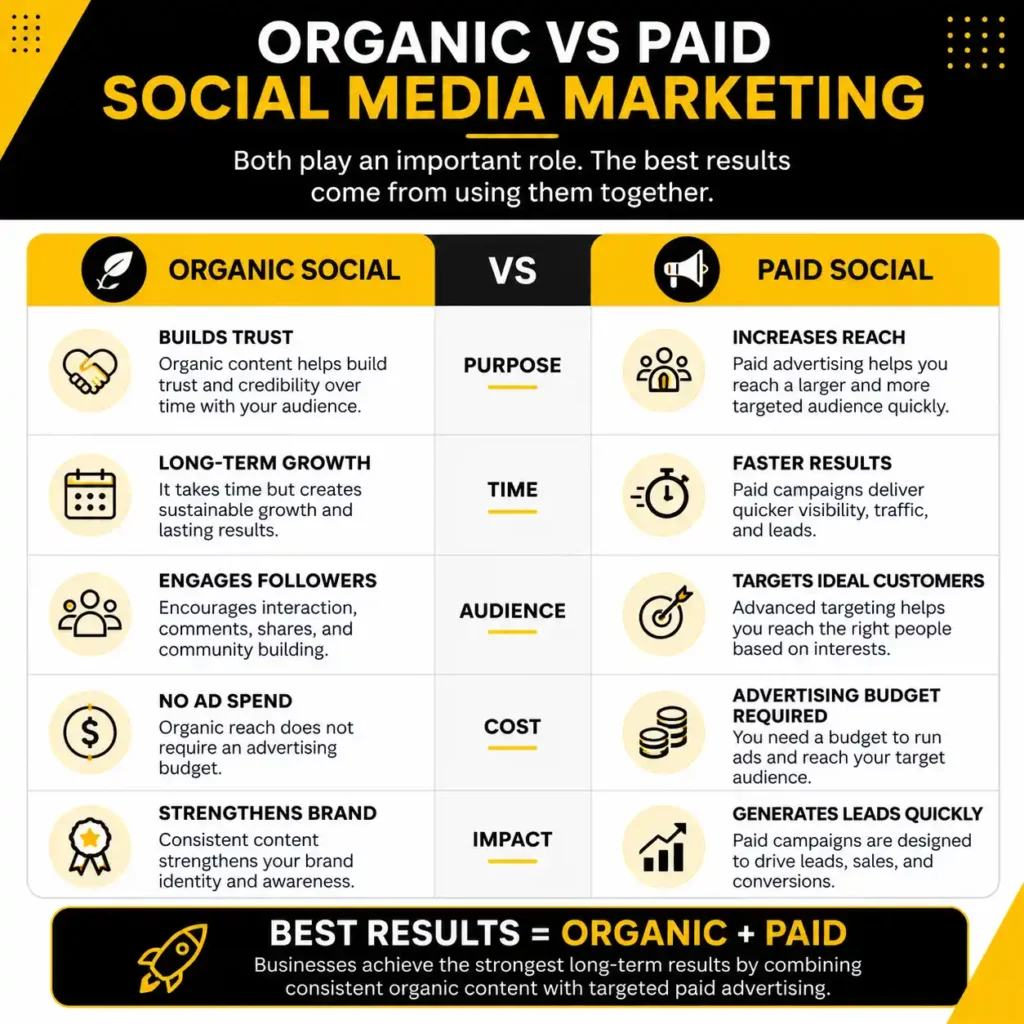
Both have different roles.
Organic social
- Builds trust
- Requires time
- Focuses on consistency
Paid social
- Delivers quick reach
- Targets specific audiences
- Useful for campaigns
Most businesses need a mix of both.
Organic creates your foundation. Paid accelerates visibility.
Why Combining Organic and Paid Social Media Works Best
Several companies depend exclusively on one of two marketing strategies: organic content posting or paid advertisements. However, the best results often come from a combination of the two. Organic marketing keeps the target audience engaged, while paid advertisements reach a wider audience, advertising to potential customers who are unaware of the business.
Often, social media accounts are the first touchpoint customers have with a business through paid advertisements. Active and engaging social media accounts respond to paid advertisements and positively influence customers to interact with and/or purchase from the business. Combining both marketing strategies enhances the customer experience and the business’s marketing techniques.
Common mistakes businesses make
Many businesses struggle because they approach social media incorrectly.
1. No clear strategy
Posting without direction leads to weak results.
2. Chasing followers
Followers don’t always mean customers.
3. Inconsistent branding
Different styles confuse your audience.
4. Expecting instant results
Social media takes time to build impact.
5. Ignoring the bigger picture
Social media works best when part of a complete marketing system.
How different businesses should approach social media
Not every business uses social media the same way.
Service-based businesses
Focus on:
- Trust
- Proof
- Clear messaging
Ecommerce brands
Focus on:
- Visual appeal
- Product presentation
- Offers
B2B companies
Focus on:
- Authority
- Insights
- Professional tone
Understanding your business type helps shape your strategy correctly.
How to plan content effectively
Instead of guessing, use a simple plan.
Start with:
- Weekly themes
- Content categories
- Clear goals
For example:
- Monday: Educational
- Wednesday: Trust content
- Friday: Engagement
Planning reduces stress and improves consistency.
Measuring Performance the Right Way
Don’t look at the stats of your gains and follows. These can tell you about your presence, but will not show you if your social media plan is helping your business develop.
Look instead at how your actions accomplish your goals, like:
- Profile visits
- Website clicks
- Messages
- Leads
- Engagement rate
- Conversion rate
These metrics indicate not only your audience’s interaction with your brand, but also whether or not your content is driving them to take action.
Make an effort to analyse your social media performance at least quarterly, or more often if possible, to identify patterns in your posts that drive the highest engagement or interaction, the most traffic, and the most enquiries. By doing so, you will be able to enhance your content strategy, increase the performance of your campaigns, and make the most of your social media to grow your business and achieve a better return on your investments in the long term.
Social Media Metrics That Matter
Social media marketing focused solely on quantifying engagement, such as tracking likes and followers, can be misaligned. That’s because engagement on social media doesn’t necessarily translate into increased sales, the ultimate goal.
An effective sales-oriented social media strategy will track website visits, inquiry form submissions, DMs, social media-related leads, sales conversions, and advertising ROI. These metrics will help you understand your social media performance and sales growth, and plan more effective marketing efforts.
Benefits of Social Media Marketing for Businesses in Dubai
- Increase brand awareness
- Build customer trust
- Generate qualified leads
- Drive website traffic
- Improve customer engagement
- Support long-term business growth
This targets another major search intent and strengthens topical authority.
When to consider professional support
If your content feels random or inconsistent, it may be time to get help.
A structured approach helps:
- Improve clarity
- Maintain consistency
- Align content with goals
Professional social media marketers know what’s new in social media advertising rules and what their target audience wants. With this knowledge, they help businesses build their social media marketing campaigns effectively and efficiently and avoid mistakes that hurt their growth.
Key facts about social media behavior
These insights reflect how users actually behave:
- Most people check social media before contacting a business
- Consistent posting increases brand recognition
- Visual content performs better than plain text
- Trust builds over multiple interactions
- Social media rarely converts instantly
- Engagement matters more than follower count
- Active profiles are seen as more credible
- Social media works best when combined with other marketing efforts
Why Businesses Invest in Professional Social Media Marketing Services
Effective social media management goes beyond simply drafting posts. Businesses are responsible for developing a content strategy, drafting verbiage, and designing posts, as well as responding to consumer inquiries, developing and studying metrics, and updating as per shifting algorithms.
By employing social media specialists with ample industry knowledge, businesses are able to develop consistency in their branding and save time with campaigns that align with their ultimate business goals. Specialists can help companies develop a social media presence that will help achieve their goals of increased brand presence, new business opportunities, and enhanced engagement with clients and customers.
Social Media Marketing in Dubai at a Glance
- Most customers check social media before contacting a business.
- Consistent posting improves brand recognition.
- Video content generally generates higher engagement than static posts.
- Organic and paid social media work best when combined.
- Trust is built through multiple interactions, not a single post.
Google often rewards scannable summaries because they improve readability.
Final thoughts
Mere content creation and engagement won’t suffice for social media marketing in Dubai. An organized and long-standing strategy can improve your business’ social media presence, aid in building and maintaining customer relationships, and enhance your business’ social media reputation. All your social media work will have a positive or negative impact on how your potential customers view your brand and may affect or determine the outcome for your potential customers.
Social media marketing has a positive long-term impact on your business. It improves customer engagement and attracts new potential customers. It is a marketing strategy that will give your business a competitive advantage.

Vertexs Digital is a Dubai-based digital agency with 10+ years of experience in website design, SEO, and social media marketing. We help businesses build a powerful online presence through high-performing websites, data-driven strategies, and result-focused campaigns. Our mission is simple—drive traffic, increase visibility, and turn visitors into loyal customers.